
US Navy Secretary John Phelan Resigns Amid Pentagon Leadership Shake-Up
US Navy Secretary John Phelan has left the Trump administration with immediate effect, according to the Pentagon, amid ongoing leadership changes, internal tensions, and heightened global naval operations involving Iran and the Strait of Hormuz.
WORLD NEWS
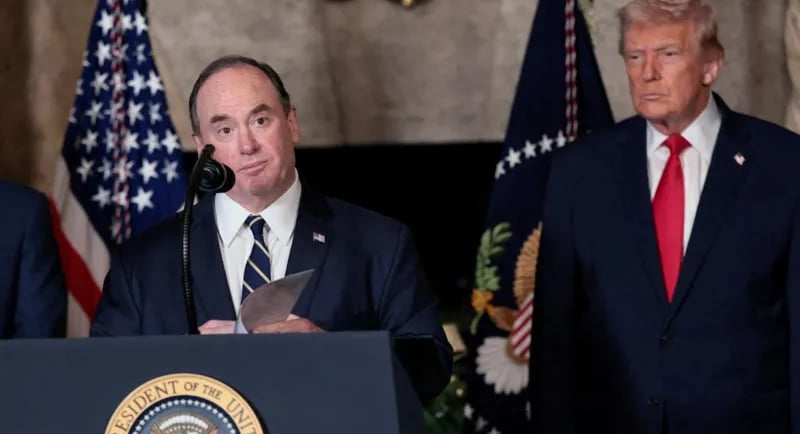
The United States Navy Secretary, John Phelan, has stepped down from his position in the Trump administration, with the Pentagon confirming that his exit takes effect immediately.
Pentagon spokesman Sean Parnell announced the development on Wednesday via a social media post, stating that Navy Undersecretary Hung Cao will assume the role in an acting capacity. The position is largely administrative but central to naval policy, operations, and budgeting.
Phelan’s departure marks the latest in a series of high-profile exits within the US military leadership in recent months, amid ongoing restructuring within the Pentagon.
No Official Reason Given
The Navy has not officially disclosed the reason for his resignation. However, reports from US media suggest the exit follows internal disagreements over shipbuilding policies and implementation of the Trump administration’s naval expansion strategy.
His resignation also comes at a time of heightened global military tension, including the US-Israel conflict with Iran and continued US naval operations linked to the blockade of the Strait of Hormuz, one of the world’s most critical oil shipping routes.
Pentagon Response
In its official statement, the Pentagon expressed appreciation for Phelan’s service.
“On behalf of the Secretary of War and Deputy Secretary of War, we are grateful to Secretary Phelan for his service to the Department and the United States Navy. We wish him well in his future endeavors,” Parnell said.
Part of Wider Military Shake-Up
Phelan’s exit follows a broader wave of leadership changes within the US defense establishment. Just weeks earlier, US Defense Secretary Pete Hegseth reportedly asked Army Chief of Staff Randy George to step down.
In addition, Gen. David Hodne and Maj. Gen. William Green were also removed from their positions in recent personnel adjustments.
Since assuming office at the Pentagon, Hegseth has reportedly dismissed more than a dozen senior military officials, including the chief of naval operations and the Air Force vice chief of staff, signalling a significant restructuring of military leadership.
Internal Tensions Over Shipbuilding
Sources cited by US media suggest Phelan’s departure may be linked to disagreements with Hegseth over the execution of the administration’s shipbuilding and naval expansion agenda.
Phelan, a civilian and former businessman with no prior military service, was appointed Secretary of the Navy in March 2025 after being nominated by President Donald Trump in 2024. He was also a known political donor to Trump’s campaign.
His tenure included support for Trump’s proposed naval expansion initiative, including plans for new heavily armed vessels under a revived “Golden Fleet” programme, which was publicly promoted at Mar-a-Lago in late 2024.
New Acting Navy Chief
Replacing him in an acting capacity, Hung Cao, a 25-year US Navy veteran, was appointed Undersecretary in October 2025.
Cao previously ran unsuccessfully for the US Senate in Virginia in 2024 with Trump’s endorsement. During his campaign, he drew attention for his outspoken views on military culture and recruitment policies.
Speaking at a debate, Cao criticised diversity and inclusion programmes in the military, emphasising a more combat-focused recruitment philosophy.
Broader Security Context
The leadership change comes amid ongoing geopolitical tensions involving the United States and Iran.
The Trump administration has maintained a naval presence in the region, including continued pressure around Iranian ports and maritime routes. The Strait of Hormuz, a critical global oil passage, remains a flashpoint, with reports of vessel seizures and heightened naval activity.
White House Press Secretary Karoline Leavitt stated that President Trump remains satisfied with the current naval posture, insisting Iran is operating from a weakened position.
However, Iranian officials have warned that reopening the Strait of Hormuz may not be possible under current conditions, citing alleged violations of ceasefire arrangements by the US and Israel.
As tensions continue to rise globally and leadership changes accelerate within the Pentagon, Phelan’s sudden departure adds further uncertainty to the direction of US naval policy in a volatile security environment.
Gran News delivers to best of the best News articles
Subscribe to our newsletter and never miss a story.
We care about your data in our privacy policy.